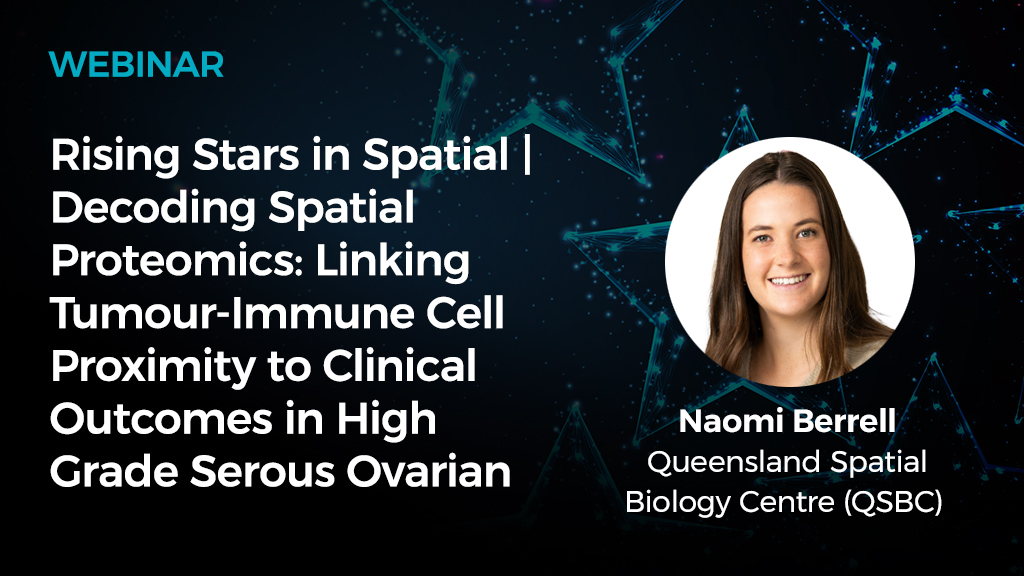
Rising Stars in Spatial | #2 Decoding Spatial Proteomics: Linking Tumour-Immune Cell Proximity to Clinical Outcomes in High Grade Serous Ovarian Cancer
Rising Stars in Spatial | #2 Decoding Spatial Proteomics: Linking Tumour-Immune Cell Proximity to Clinical Outcomes in High Grade Serous Ovarian Cancer
Webinar | Thursday, April 10, 2025
High-grade serous ovarian cancer (HGSOC) is a lethal gynecological malignancy, most often detected at a late stage of the disease, at which point response to therapy is only seen in a minority of patients. As new treatments are introduced into practice, there is a clinical need to understand which treatment will be most beneficial for individual tumors.
High-plex spatial proteomics allows for the mapping of the tumor microenvironment, overlaying cell phenotypes, functional markers, and metabolic states of these cells, providing greater insight into tumor biology.
In this webinar, Naomi Berrell, Research Assistant at the Queensland Spatial Biology Centre (QSBC), describes the analysis of HGSOC tumor samples from 49 patients using high-plex spatial proteomics to better understand the tumor microenvironment (TME) and how this contributes to patient survival in a cisplatin-resistant cohort. Using a 48-plex cyclic immunofluorescent protein panel, immune cell interactions with tumor cells, based on their functional and metabolic profiles, were analyzed. Key insights from this study include that the proximity between immune cells and metabolically dysregulated tumors correlates with overall survival.
Video
Speaker
Naomi Berrell
Research Assistant, Queensland Spatial Biology Centre