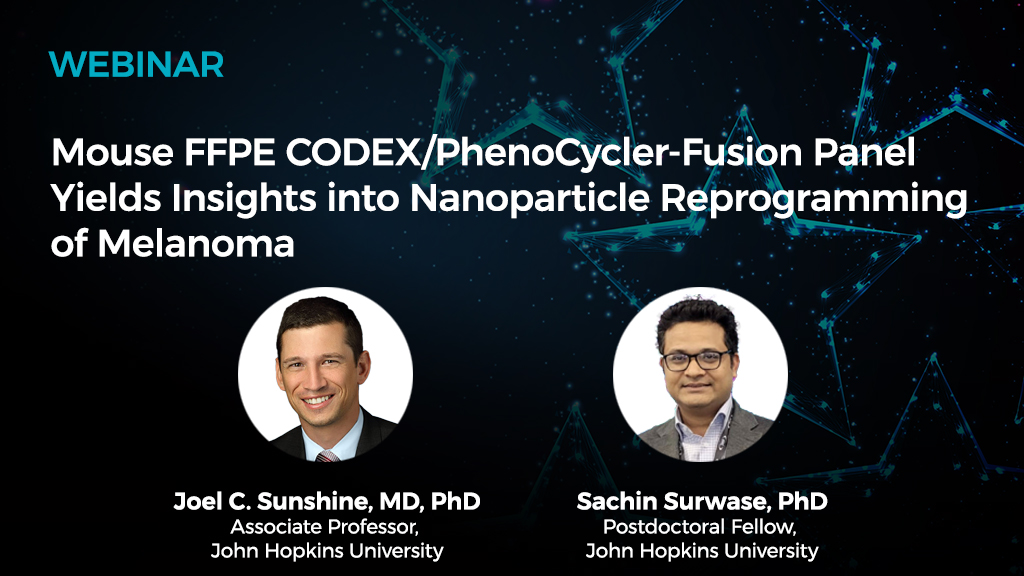
Mouse FFPE PhenoCycler-Fusion Panel Yields Insights into Nanoparticle Reprogramming of Melanoma
Mouse FFPE PhenoCycler-Fusion Panel Yields Insights into Nanoparticle Reprogramming of Melanoma
Webinar | Thursday, May 22, 2025
The tumor microenvironment (TME) is highly complex, consisting of various immune cells, fibroblasts, and other supportive cells that communicate closely. Several techniques, including flow cytometry and single-cell sequencing, are employed to study the intricacies of the TME. However, these methods lack spatial context, and most current immunofluorescence/immunohistochemistry (IF/IHC) imaging applications are limited to approximately three markers.
Co-detection by indexing (CODEX) is an emerging high-plex technique based on DNA barcoding technology, allowing for the visualization of biomarkers in tumor regions while maintaining tissue architecture. Unfortunately, while more options exist for fresh-frozen (FF) samples, very few validated antibodies are accessible for murine formalin-fixed paraffin-embedded (FFPE) tissues. FFPE offers several advantages over FF tissue, primarily in terms of handling and storage ease, as well as the ability to create tissue/tumor microarrays (TMAs).
In this webinar, speakers Dr. Joel Sunshine and Dr. Sachin Surwase will explain how they tackled this gap in ultrahigh-plex imaging and designed and developed a mouse FFPE CODEX panel to study the TME in a murine melanoma model, applying it to samples of murine melanoma treated with nanoparticle-based genetic reprogramming.
The panel can be adapted to examine different murine organs and various tumor types.
Video
Speaker
Joel C. Sunshine, MD, PhD
Assistant Professor of Dermatology, Pathology, Oncology, and Biomedical Engineering·John Hopkins University
Biography
Dr. Sunshine is an Assistant Professor of Dermatology, Pathology, Oncology, and Biomedical Engineering, as well as the Program Director of the Dermatology Residency training program at Johns Hopkins. Dr. Sunshine co-leads the Training and Dissemination section and serves as a co-PI of TR&D2 of the NIH P41 funded Johns Hopkins Translational ImmunoEngineering (JH-TIE) BTRC. The Sunshine lab is focused on developing new approaches to activate the anti-tumor immune response to skin cancer using micro- and nanoparticle formulations, specifically developing novel approaches using non-viral nucleic acid delivery systems. Additionally, to better understand the immune response to skin cancer in human tumors, we are using multiplex immunofluorescence (mIF), spatial transcriptomics, microdissection, and artificial intelligence to develop improved biomarkers of treatment response and resistance.
Sachin Surwase, PhD
Postdoctoral Fellow·John Hopkins University
Biography
Dr. Surwase graduated with a BS in Pharmacy and an MS in Pharmaceutics from India and earned his PhD in Chemical and Biomolecular Engineering from the KAIST in South Korea. Dr. Surwase is a postdoctoral fellow in the lab of Dr. Jordan Green and Dr. Joel Sunshine, whose ongoing research focuses on modulating the tumor microenvironment through non-viral gene delivery and visualizing it with multiplex immunofluorescence (mIF) imaging.